Most people shopping for a hot tub spend hours debating jet counts and shell colors, then give almost no thought to the seats themselves. That’s a mistake. The way to explain hot tub seating types is to start with a simple truth: the seat you sit in determines how much of that therapeutic jet power actually reaches your body. A poorly designed seat with 40 jets delivers less real benefit than a well-designed one with 20. This guide breaks down every major seating type, what each one does, and how to choose the right mix for your lifestyle, your body, and the people you soak with.
Table of Contents
- Key Takeaways
- How hot tub seating types actually work
- Why ergonomics matter more than you think
- Matching seat types to how you actually use your tub
- Choosing the right seating arrangement for your home
- My honest take on seating and why buyers get it wrong
- Find your perfect hot tub at Lifestyleoutdoor
- FAQ
Key Takeaways
| Point | Details |
|---|---|
| Four core seating types | Lounge seats, captain’s chairs, therapy seats, and cool-down seats each serve a distinct function. |
| Ergonomics beat jet count | Seat depth and backrest angle determine whether jets actually contact your muscles effectively. |
| Mix seat types strategically | Combining loungers with upright seats serves both relaxation and social use in one tub. |
| Apply the minus-two rule | A tub marketed for six people comfortably seats four adults without cramping. |
| Always do a wet test | Sit in every seat for 15 minutes with jets running before committing to a purchase. |
How hot tub seating types actually work
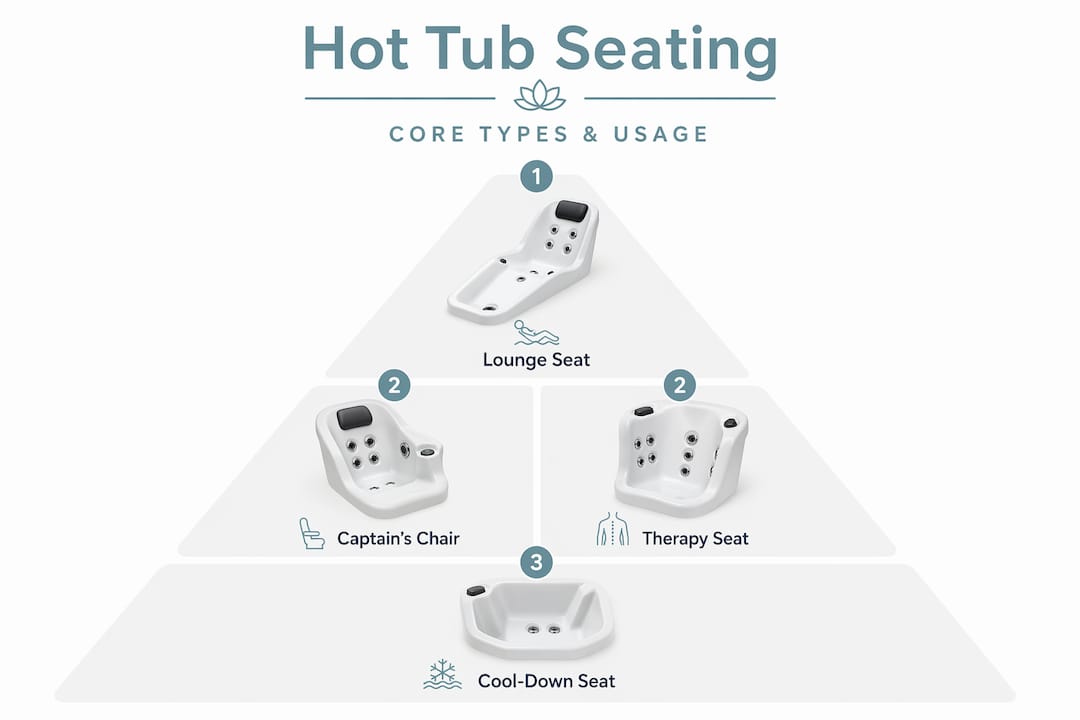
Hot tub seating is categorized into four primary types: lounge seats, captain’s chairs, therapy seats, and cool-down seats. Each one positions your body differently in the water, which changes everything about the soak experience.
Here is what each type looks like and what it is built to do:
- Lounge seats are the most recognizable. They recline at a shallow angle so your body stretches nearly horizontal in the water. Because more of your surface area is submerged, jets can target your calves, hamstrings, lower back, and shoulders in a single seat. Loungers are the go-to for full-body relaxation after a long day.
- Captain’s chairs are deep, upright corner seats. They position you with your back fully against the shell wall and your feet dropping straight down into the footwell. The upright angle puts jets directly in line with your upper back and neck, making them the best seat for targeted upper-body therapy.
- Therapy seats are purpose-built for specific muscle groups. You might find a seat engineered for the lumbar region, another for the shoulders, and another for the legs. These seats are placed and angled so the jets hit precisely where the design intends, with little room for adjustment.
- Cool-down seats sit higher and shallower than the others. They keep most of your torso above the waterline, which lets your body temperature drop while you stay in the tub. They also double as easy entry and exit points and are perfect for kids or anyone who wants a low-intensity soak.
Pro Tip: If you plan to use your hot tub primarily for sleep improvement or stress relief, prioritize at least one full-body lounger. If conversation and socializing are the main draw, lean toward captain’s chairs and upright therapy seats that keep everyone at eye level.
Why ergonomics matter more than you think
Buying a hot tub based on jet count alone is like buying a mattress based on spring count. The number matters far less than how well the design fits your body. Seat depth dictates buoyancy and jet effectiveness. When a seat is too shallow, your body floats upward, and the jets that were aimed at your lower back end up shooting past your hips entirely.
The backrest angle is just as critical. Your spine has a natural S-curve, and a well-designed hot tub seat mirrors that shape. When the backrest contours your spine correctly, jet nozzles stay in continuous contact with your muscles throughout the soak. A flat backrest, by contrast, creates gaps between your body and the jets, breaking the therapeutic contact and reducing the benefit significantly.

Footwell design rounds out the ergonomic picture. Proper footwell design allows you to brace your feet and lock your body into position. Without that anchor point, jet pressure actually pushes you forward and out of alignment. You end up spending energy staying in place rather than relaxing, and the jets lose their effectiveness because your body keeps shifting away from them.
Here is a quick breakdown of the three ergonomic factors to evaluate in any seat:
- Seat depth: Should submerge your shoulders when seated upright, keeping the water level at neck height for full coverage
- Backrest angle: Should follow the natural curve of your spine without forcing your lower back to flatten or arch unnaturally
- Footwell design: Should include a raised toe ledge or angled floor so your feet can brace against jet pressure and hold your position
Pro Tip: Bring your partner or a friend to any showroom visit. You will quickly discover that a seat depth perfect for someone 5’4" can leave someone 6’2" with jets hitting the wrong spot entirely. Seating fit is personal, and you need to test it at your height.
Seating layout often outweighs jet count in overall comfort and effectiveness, which is why spending time evaluating the ergonomics of each seat during your showroom visit pays off more than comparing spec sheets.
Matching seat types to how you actually use your tub
Not every seat works equally well for every situation. Understanding the trade-offs helps you choose a seating arrangement that serves your real life rather than an idealized one.
| Seating type | Best for | Trade-offs |
|---|---|---|
| Lounge seat | Full-body relaxation, solo soaks, sleep prep | Limits face-to-face conversation; takes up more tub space |
| Captain’s chair | Upper back and neck therapy, longer soaks | Less lower-body coverage than a lounger |
| Therapy seat | Targeted muscle relief, chronic pain management | Fixed position limits flexibility of use |
| Cool-down seat | Families with kids, entry/exit ease, temperature breaks | Minimal jet contact; not ideal for deep therapy |
A balanced mix of seating types accommodates different body types and preferences during the same session. Think about the people who will actually use your tub regularly. A couple with different body types and different needs will get more out of a tub that has one lounger, two captain’s chairs, and a cool-down seat than one packed with six identical therapy seats.
Families with children benefit especially from cool-down seats. Kids tend to overheat faster, and a raised seat that keeps them partially above water gives parents peace of mind while still letting everyone share the experience. For households where one person is recovering from a back injury while another just wants to decompress, mixing therapy seats with lounge seats turns one tub into something that genuinely works for both of them.
If entertaining is your priority, upright captain’s chairs and therapy seats create a natural social circle where everyone can make eye contact and hold a conversation. Loungers, while supremely comfortable, position you semi-reclined and looking up, which makes group conversation awkward over time. This is why many buyers who prioritize socializing choose tubs with one lounger and the rest upright seating.
You can also read more about the full benefits of hot tub ownership to see how different seating types connect to specific wellness outcomes.
Choosing the right seating arrangement for your home
Once you understand the types, the real work is matching them to your specific situation. Here is a practical process for getting that right:
-
Count your regular users, then subtract two. The minus-two rule means a tub marketed for six people comfortably seats four adults. Overcrowding eliminates elbow room and makes it impossible to fully use any seat’s ergonomic features.
-
Map out your typical use. If you soak alone for therapy three nights a week and host friends on weekends, you need a different seating layout than a family that mostly uses the tub together. Write down your actual scenarios before you visit a showroom.
-
Account for height differences. Seat depth affects everyone differently based on height. Someone shorter than average will submerge more deeply in the same seat that leaves a tall person with jets grazing their lower ribs. Test every seat at your height before deciding.
-
Think about elbow room. Footwells that are too narrow force knees together and make it hard to stay comfortable for more than 10 minutes. Ask the dealer to show you the footwell dimensions and sit in the seat long enough to notice any pinch points.
-
Do a wet test before you buy. Sit in every seat for 15 minutes with the jets running. Water should reach shoulder level for full therapeutic benefit. This step alone eliminates most buyer’s remorse.
Pro Tip: Ask the showroom to fill the tub to operating level for your test. Some dealers run wet tests with lower water levels that don’t reflect real soaking conditions, which means the seat comfort you experience may not match what you get at home.
For a deeper look at putting a full seating layout together, the homeowner’s hot tub guide at Lifestyleoutdoor walks through configuration decisions step by step.
My honest take on seating and why buyers get it wrong
I’ve watched hundreds of buyers walk into a hot tub purchase focused almost entirely on jets, size, and aesthetics. Seating ergonomics almost never come up until they call back three months later wondering why the tub doesn’t feel as good as it did during the demo. The demo tub was usually better fitting. Their purchase was not.
The biggest mistake I see is treating all seats as equal because they’re in the same tub. A captain’s chair in one model can be three inches deeper than the same-named seat in a competing model. That difference changes who can use it comfortably and how effective the jets are for that person. Spec sheets don’t capture it. Only testing does.
I’ve also seen buyers overload their tub with therapy seats because they sound impressive on paper. In practice, therapy seats lock you into a fixed position, and after 20 minutes, most people want to shift around. A mix of seat styles gives you flexibility. You can start in the therapy seat for your lower back, move to the lounger to decompress, and finish in the cool-down seat before you get out. That kind of movement is what turns a soak into an actual recovery session.
My personal recommendation: prioritize one great lounger, at least two upright seats with genuine spinal support, and one cool-down seat. That combination handles almost every use case a household will encounter.
— Philipp
Find your perfect hot tub at Lifestyleoutdoor
Understanding seating types is just the beginning. The next step is finding a tub where those seats actually fit your body and your lifestyle.

Lifestyleoutdoor carries an extensive selection of hot tubs from trusted brands including Jacuzzi®, Caldera®, Hot Spring®, and Fantasy Spas®, each offering distinct seating configurations designed for genuine ergonomic comfort. Whether you want a full-body lounger, targeted therapy seats, or a social layout built for weekend entertaining, the team at Lifestyleoutdoor can walk you through every option in person. Browse the full collection of hot tubs for sale to explore models by seating style and capacity, or visit a Southern California showroom to do a hands-on wet test before you decide. If you want expert help narrowing down your seating configuration, the Lifestyleoutdoor team is ready to guide you through designing your ideal setup from the first seat to the last.
FAQ
What are the four main hot tub seating types?
The four main types are lounge seats, captain’s chairs, therapy seats, and cool-down seats. Each positions your body differently in the water to serve distinct relaxation, therapeutic, or social functions.
Which hot tub seat is best for back pain?
Therapy seats and captain’s chairs are most effective for back pain because they align jets with specific spinal zones and keep your back in full contact with the water. The key is ensuring the backrest contours your natural spinal curve.
How many seats should a hot tub have?
Focus on seat variety rather than seat count. A well-configured tub for four adults might have one lounger, two captain’s chairs, and one cool-down seat, giving everyone a different option based on how they feel that day.
Does seat depth really affect hydrotherapy?
Yes. Shallow seats cause your body to float upward, moving your muscles away from the jets. Deeper seats keep your shoulders submerged and ensure jets stay in contact with the intended muscle groups throughout your soak.
What is the minus-two rule for hot tub seating?
The minus-two rule means you should plan for two fewer users than the tub’s advertised capacity. A six-person tub comfortably seats four adults with enough room to use each seat’s ergonomic features without crowding.